

Reduced Maintenance
The lower maintenance requirements of electric actuators are helping drive their use over hydraulics as well. According to Tolomatic, electric actuation has very little to no maintenance over the life of a machine.
Use of planetary roller screws in electric actuators has enabled the longer life and low maintenance desired by many machine users, the company noted. In addition, the power elements (power screw and thrust bearings) of the actuator are usually greased for life. But in-field greasing methods can be used if needed.
The other component on an electric actuator which could wear is the rod seal. If failure occurs, though, the actuator can still operate as desired because it does not hold pressure like a hydraulic component would. And the seal can be replaced if damaged.
A hydraulic system typically requires routine maintenance to change the oil and filters in order to ensure continued performance. It may also be necessary to replace fittings, valves or other components over time.
Tolomatic noted there is also a growing lack of skilled maintenance people knowledgeable in hydraulics which is helping fuel the speed of adoption for electric actuation.
Improved Precision and Position Feedback
One of the top reasons electric linear actuators are chosen over hydraulic cylinders is the motion control capabilities they provide. The pairing of electric actuators with a servo drive and motor system allows users to know with certainty the actuator’s position at all times as well as its speed, accelerations, forces, and more. Whereas a hydraulic system would require a number of expensive instruments to be added to the system to get similar information.
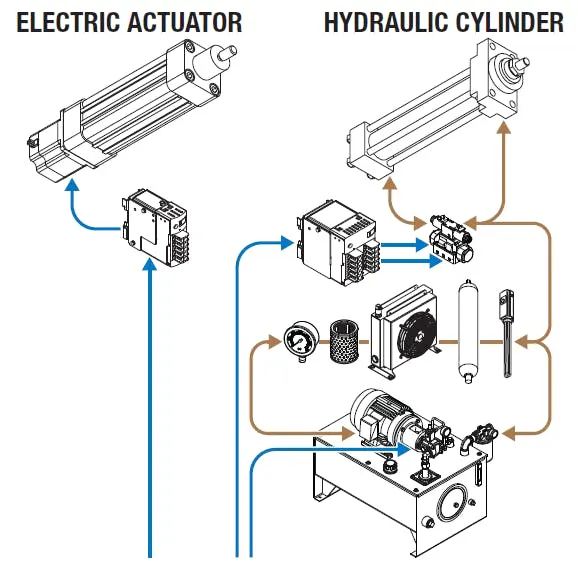
These capabilities enable more accuracy and repeatability to be achieved with electric actuators which benefits a range of industrial applications, especially as they become more automated.
Additional motion control benefits offered by electric actuators outlined by Tolomatic include:
- thrust capabilities on par with hydraulics are possible,
- consistent monitoring of torque allows appropriate force control without maintenance or system adjustment,
- closed-loop control enables multiple positions to be achieved without the use of external sensors.