

This product series supports multiple communication methods, including Pulse, Analog, and Industrial Fieldbus (RS485, Modbus RTU, Ethernet). These communication options ensure easy integration with various control systems and automation platforms.

1. Multiple Communication Options for Diverse Control Needs
1. Pulse Control — Fast and Accurate Point-to-Point Positioning
The servo drive supports Pulse and Direction control. A PLC or motion controller sends pulse commands for precise positioning.
Features:
Simple control logic and easy setup
High positioning accuracy and fast response
Ideal for point-to-point or repeat motion
Compatible with major PLC brands such as Mitsubishi, Panasonic, Keyence
Typical applications include positioning, pick-and-place, indexing, and linear reciprocating motion.
2. Analog Control — Smooth and Adjustable Speed or Force Regulation
The system supports 0–10V voltage input or 4–20mA current input for continuous control of speed or force.
Features:
Easy integration with traditional PLCs
Suitable for constant-speed or constant-force operations
Smooth motion response
Low cost with simple wiring
Typical applications include press-fitting, force control, speed control, and testing equipment.
3. Industrial Fieldbus — High-Speed, Intelligent, Real-Time Network Control
(1) RS485
A widely used industrial differential communication standard.
Advantages:
Strong noise immunity
Transmission distance up to 1200 meters
Supports multi-drop networking
Suitable for economical control systems
(2) Modbus RTU (Based on RS485)
A popular open serial communication protocol compatible with many PLCs, HMIs, and industrial controllers.
Advantages:
Simple and easy-to-use protocol
Low cost and highly reliable
Allows reading and writing of key parameters such as position, speed, and status
Suitable for mid- or low-speed automation and monitoring applications
(3) Ethernet (Industrial Ethernet Protocols)
Supports industrial Ethernet protocols such as Ethernet/IP or Modbus TCP, enabling fast and efficient data networking.
Advantages:
High-speed data exchange ranging from 100 Mbps to 1 Gbps
Excellent noise resistance and long-distance communication capability
Enables multi-axis synchronization and advanced motion functions
Easily integrated with MES, SCADA, and smart factory systems
Typical applications include high-precision assembly lines, automated production cells, high-speed handling, and multi-axis coordinated motion.
4. Key Product Advantages
High precision positioning with micrometer-level repeatability
High thrust output with multiple cylinder sizes and screw pitches available
Robust and durable structure suitable for demanding industrial environments
Intelligent monitoring with real-time feedback on position, speed, load, temperature
Flexible installation options including flange, foot mount, side mount, and clevis types
5. Application Industries
Automated assembly lines
Electronics and semiconductor manufacturing
Automotive parts press-fit and inspection
Medical and laboratory testing equipment
Packaging machinery
CNC auxiliary equipment
Smart warehousing and sorting systems
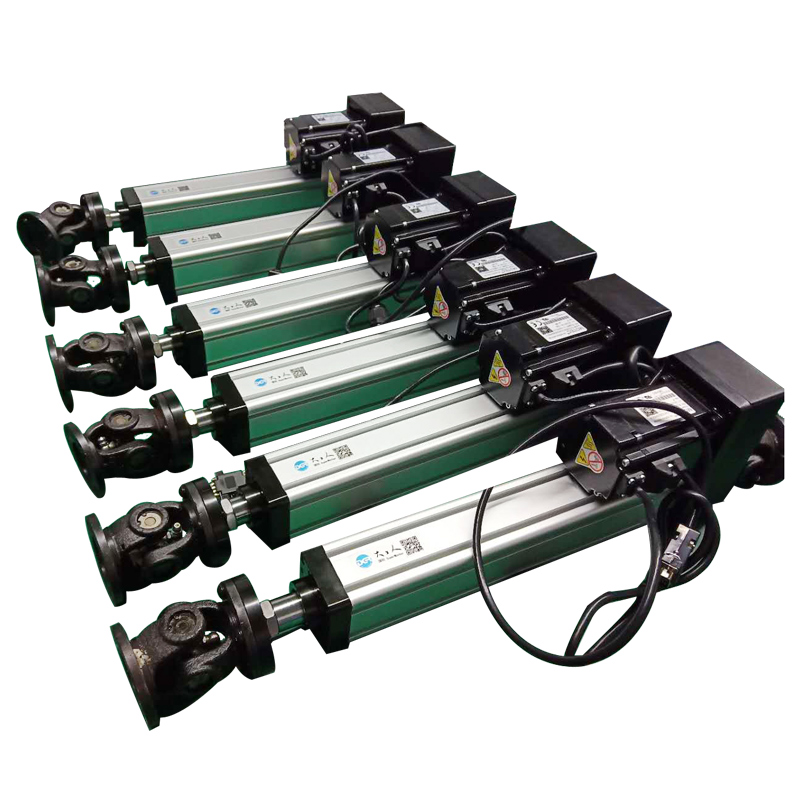
6. Conclusion: A Smart Electric Cylinder Built for Any Control System
Whether your system uses Pulse, Analog, or Industrial Fieldbus communication, this servo electric cylinder integrates seamlessly and provides a fast, stable, and precise linear motion solution for modern automation environments.